BERLIN — Germany’s parliamentary budget committee has approved 11 major defense procurement projects worth more than €2.5 billion ($3 billion), bringing the country’s tally on equipment spending for 2025 to over €33 billion across 73 major projects.
The Dec. 3 approval includes a significant expansion of the Bundeswehr’s G95 assault rifle order, additional Joint Strike Missile purchases for future F-35A fighters and new artificial intelligence-powered surveillance systems.
Among the more novel systems approved is URANOS AI, an artificial intelligence-powered surveillance platform designed to process large volumes of reconnaissance data from drones, satellites and radar stations along NATO’s eastern flank. The system will initially be integrated into Germany’s brigade in Lithuania − Panzerbrigade 45 − with plans to eventually equip all German army brigades.
The AI system reflects growing German interest in autonomous battlefield intelligence following the employment of such capabilities in the Ukraine war.
The committee also approved continued procurement of Kongsberg’s Joint Strike Missile for Germany’s incoming F-35A fighters, building on an initial order placed jointly with Norway in June. The long-range cruise missile is designed to be carried internally in the F-35’s weapons bay so as not to disturb the fighter’s stealth capabilities.
Additional approvals include a framework contract for “a high three-digit number” of Aladin reconnaissance drones for close-range surveillance, more than 1,700 military all-terrain vehicles, and heavy transport trailers capable of moving Leopard 2 main battle tanks.
Under German law, approval by the parliamentary budget committee is required for procurement projects that will cost more than €25 million ($29 million).
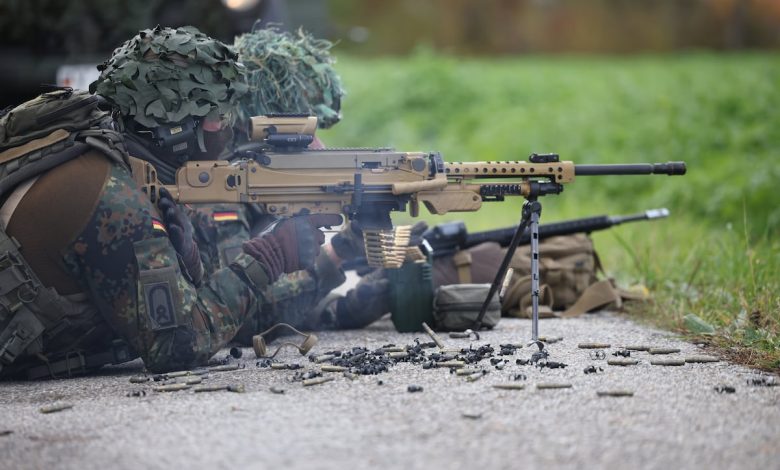
The top ticket item in the latest shopping spree is the Bundeswehr’s expanded procurement of the G95 rifle system − Heckler & Koch’s HK416A8 model − beyond the approximately 120,000 units initially approved in late 2022. Bloomberg reported last week that the new order could bring the total to as many as 250,000 rifles, though the Defense Ministry has not disclosed the exact number.
The ministry also approved procurement of laser light modules that enable the G95 to be used with night vision goggles in low-visibility conditions.
This year’s spending surge comes as part of Germany’s declared goal of making the Bundeswehr Europe’s most powerful conventional army. This includes the expansion of the Bundeswehr to approximately 460,000 personnel − including up to 260,000 active troops − up from roughly 180,000 active soldiers currently. Defense Minister Boris Pistorius has committed to raising defense spending to 3.5% of GDP by 2029, which would solidify Germany’s position as the continent’s top military spender.
Linus Höller is Defense News’ Europe correspondent and OSINT investigator. He reports on the arms deals, sanctions, and geopolitics shaping Europe and the world. He holds a master’s degrees in WMD nonproliferation, terrorism studies, and international relations, and works in four languages: English, German, Russian, and Spanish.